
The Last 8%
Saying the Quiet Part Out Loud

** I will have some exciting news to share shortly. A nasty little tease, I know. Forgive me. Patience, my parents have told me, is a virtue. **
In the meantime, I wanted to share a story that crossed my path recently and got me thinking. How much of success is rooted in effective communication?
Every sport has coaches — and often an entire organizational infrastructure — built around its players. In sports, unlike in business, we can see communication play out before us. Cameras flash to the moments of highest intensity, the dramatic tension, when emotional arguments spill forth on the sidelines or in the dugouts.
What appears to be a breakdown in communication might, given the right environment, be healthy — and even beneficial.
A recent article in the Harvard Business Review by an Olympic performance coach JP Pawliw highlights what he feels is becoming a barrier to team success, both on the field and in the boardroom:
An inability or unwillingness to have tough conversations.
Pawliw’s team surveyed 34,000 workers about risks they encounter in the normal course of fulfilling their job. They identified a notable gap between the risks they do take and the ones they feel they should. The results showed, for example, that people leave out or avoid approximately 7.56% of what they want to say in a difficult work conversation.
In other words, they will share ~92% of their feelings, but when they get to the more challenging parts, they will back down from having the full discussion.
Pawliw calls this retreat the fundamental conflict of performance. Risk-taking goes against our biology, which rewards self-preservation. But successful organizations have risk-takers that fulfill that last 8% and complete those sometimes-tough assessments. It’s vital to the ability to outmaneuver competitors and shake up the status quo. Think Billy Beane and the “Moneyball” Oakland As.
Pawliw identifies the characteristics of organizations that foster this type of risk-taking — and those that don’t. I thought the results were illuminating for a broad number of domains, both within sports and beyond.
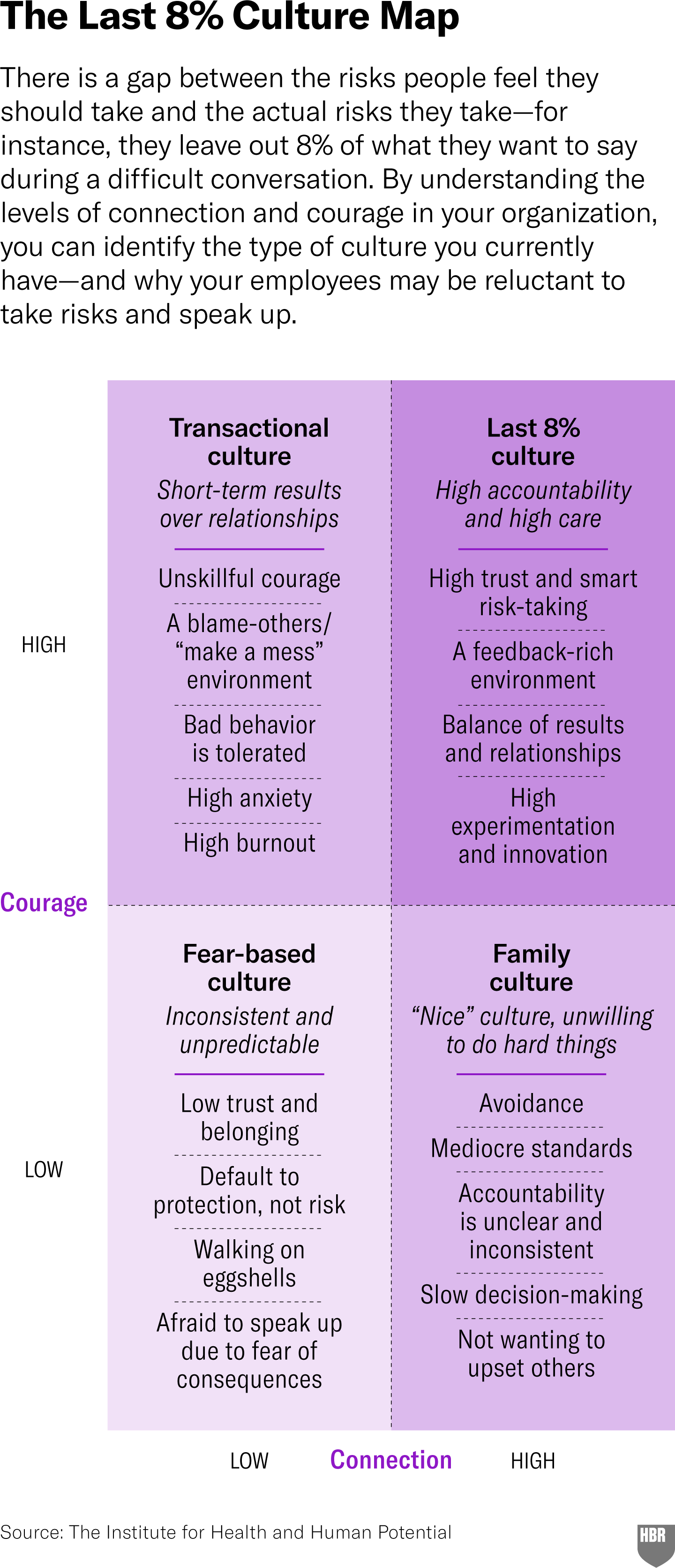
Pawliw said that the largest percentage of respondents to his surveys identified as belonging to teams with a “family culture,” which on the surface sounds enviable. Indeed, many teams strive to create a “family culture” — and it would seem more beneficial to cultivating risk-taking than a “fear-based culture.”
But in a family culture, Pawliw suggests, people may “sugarcoat communication,” breeding resistance to making touch decisions or pointing out “inconvenient truths.” That still leaves the last 8% void unfilled and may be responsible for struggles to reach a team’s true potential.
Alternatively, in a “transactional culture,” there is more risk-taking among employees, but the benefits aren’t generally sustainable. Managers may not be afraid to hold back on going the full 100% with their feedback, but the team culture isn’t there as support, creating a situation more susceptible to employee burn out and withdrawal.
“The last 8% culture” is, as you might expect, a healthy mix of “both high culture and high connection.” The environment is “feedback-rich,” which enables people to take risks, but accountability is delivered “with high care.” It is a culture that fosters innovation because employees know where they stand. The drive for results is counterbalanced by deep concern about relationships.
It’s food for thought as we continue our journey trying to understand some of the hidden “it” factors underlying skill, performance, and success in any domain.
I hope, whatever you are doing, you feel emboldened to go the last 8% and supported in whatever comes from it.
‘Til next time,
Zach
Links
Is marathon running linked to colon cancer? … Gatorade: We want to see women sweat … The performance benefits from spitting … MLB players return from injury faster if their contract is expiring … What sports rivalries can tell us about motivation … The latest nutrition fad in cycling: broccoli juice … First of its kind project to investigate the impact of sleep on peak performance in female athletes … College football’s $1 million strength coach … The world’s first robot games were a clumsy mess